Showing posts with label scientists. Show all posts

Thursday, May 07, 2015

A Name in Exam of English Language Course

On May 5, 2015, a friend of mine, Chiara Maieron, updated her status on Facebook, writing, "Feeling spooky. Barbara of urso [note by the author: an Italian television host and actress] has started to follow me on twitter ..."

I read this update and found a comment on it by a friend of Chiara. His name was Sabino Civita. I wrote the following comment irrelevant to Chiara's topic. "Hi Sabino Civita, I know the name Tullio Levi-Civita, an Italian mathematician, famous for his work on absolute differential calculus (tensor calculus) and its applications to the theory of relativity."

Chiara replied to this comment: "Hi Tatsu, I am afraid Sabino is not such a fine mathematician." Then, Sabino wrote, "Chiara is right, Tatsuo. I'm only an old philosopher. And not a fine one ..."

In reply to the above, I wrote my memory about Levi-Civita as follows: "Thanks, Sabino, for your reply. I'm a not-fine, old physicist. I first learned the name of Levi-Civita from a problem in an exam of English language course in our second-year class (Class 1) of Science Faculty at Kyoto University. Our teacher of English language quoted an English passage about Einstein's work, including the names of Levi-Civita and the German mathematician Cristoffel, to make us translate it into Japanese. At that time, I didn't know how to pronounce Civita. So, I wrote his name in my answer sheet in Japanese phonetic characters like the pronunciation of "Sivita." However, a good friend of mine in that class told me that he had been able to guess the correct Italian pronunciation of Civita." [Partly modified from the original message.]

The good friend of mine later became quite a fine physicist. His name was Kazumi Maki, who mostly worked at the University of Southern California in USA as a theorist on superconductivity. (I wrote an obituary for him here.)

Our teacher of English language thought that we, the students of Science Faculty, would like the story about Einstein and write good answers. However, the passage was rather difficult for the second-year students. I was rather good at English but did not know yet that "mechanics" meant the physics about the effects of forces on objects. So, I translated this word into a Japanese word of meaning "mechanical engineering." (What did I suppose about engineering based on relativity? It was years before the appearance of high energy accelerators and GPS.) Kazumi made a correct translation also for this word.

Months later, some members of the second-year classes (Class 1 and Class 2) were reading together a text of special relativity written in Japanese. Once we had the occasion to have a reading time in the office of Professor Shohei Tamura, who was senior to Professor Hideki Yukawa. Looking at the bookshelf in the office, Yoshio Sumi, who belonged to Class 2 and possibly attended an English language course given by a teacher different from ours, found there a book written by Levi-Civita and said, "Levi-Civita, a strange name!"

After a while, Professor Tamura said, "Sumi, you would have difficulty in marriage in the future." Yoshio was surprised to say, "Why?" Professor Tamura said, "Professor Yukawa's wife has the first name of Sumi. So, if you would marry to the girl of the same name as Professor Yukawa's wife, her name would become quite strange one, Sumi Sumi." Later, Yoshio became a theorist on high-energy physics at Hiroshima University. I don't know his wife's name.

Tuesday, December 23, 2014

Wrong Attribution of Nationality


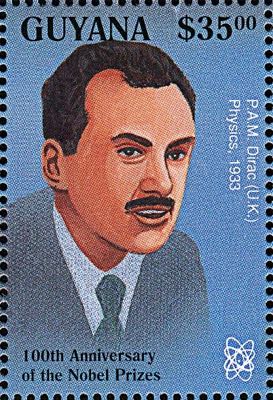
The postage stamp of Dirac, issued in Guyana, 1995; taken from Joachim Reinhardt's Web site, "Physics-Related Stamps."

On page 12 of Dave Goldberg's The Universe in the Rearview Mirror: How Hidden Symmetries Shape Reality (Penguin, 2013), I have found the words, "the French physicist P. A. M. Dirac." Dirac was an English. However, there is the following story related to French language: In his childhood, Dirac was forced to speak in French by his father, who was a French teacher, and it became one of the causes that made him a man of few words.

There was a similar error, "Yukawa H., Japanese–French" on page 494 (Biographical Index) of MacMillan Dictionary of the History of Science, edited by W. E. Bynum, E. J. Browne and Roy Porter (MacMillan, 1983).

In 1987, I wrote John Gribbin about minor errors in his book, In Search of the Big Bang (1986, Bantam). On of the errors I pointed out was as follows:
In line 10 from bottom on page 313, the two theorists Yoichiro Nambu and M. Y. Han are referred to as Japanese. However, Han is not Japanese but Korean. I think that this error was overtaken from A. Pickering's Constructing Quarks. L. M. Brown pointed out the same error in his review of that book [Science Vol. 228, p. 857 (1985)]. — Taken from my Web site essay "In Search of Errors," which is just the quotation of the letter addressed to Gribbin.

Why is the nationality of theoretical physicists sometimes wrongly attributed? The probable reason I think is as follows: Nationality is less important in the history of physics or science than in the history of other human activities, so that authors writing about historical events of physics or science are not so careful about it.

(Modified and extended from the Facebook post "Gross Errors" written on December 14, 2014.)

Tuesday, January 17, 2012

Einstein's Equation for Success

The equation for the equivalence of mass and energy, E=mc2, was discovered by Albert Einstein, and is particularly popular. Do you know Einstein's equation for success in life? It is also quite simple and yet has a deep meaning.
If A is success in life, then A equals x plus y plus z. Work is x; y is play; and z is keeping your mouth shut. — Albert Einstein
Rewriting the above words in the form of an equation, we get:
A = x + y + z,
where A = success, x = work, y = play, and z = (mouth shut).

We know the following two proverbs: (1) All work and no play makes Jack a dull boy. (2) Speech is silver, silence is golden. Einstein succeeded in unifying these proverbs into a single equation, though his quest for a unified theory of everything was too much ahead of time and fruitless.

I have learned the above words of Einstein from Ref. 1, but do not find them at least in the original edition I have of Ref. 2.

Note added later: The source of Einstein's words given here is described in Ref. 3 as follows:
Said to Samuel J Woolf, Berlin, Summer 1929. Cited with additional notes in The Ultimate Quotable Einstein by Alice Calaprice and Freeman Dyson, Princeton UP (2010) p 230.

References
  1. RSICC Newsletter, No. 486, Radiation Safety Information Computational Center, Oak Ridge National Laboratory, Oak Ridge, Tennessee, U.S.A. (August 2005).
  2. A. Calaprice, ed., The New Quotable Einstein (Princeton University Press, Princeton, 2005; the original edition The Quotable Einstein published in 1996).
  3. "Albert Einstein," Wikiquote, at the end of "1920s" (14 January 2012, at 18:41).

Sunday, January 23, 2011

Feynman and the Mirror Puzzle

On January 19, 2011, I found an online article about Feynman [1]. This article is a must read for Feynman fans, and I am sure that the person who is not yet a Feynman fan would also become a Feynman fan after reading it. I posted the following comment on it to express my little thought about Feynman.
It's regrettable that the publication of our paper that might supersede Feynman's explanation of the mirror puzzle was made after his passing. It would have been quite pleasant to talk with him about this puzzle.
The mirror puzzle is a fairly famous teaser expressed as: "Why does a mirror reverse left and right but not top and bottom?" Recently I just wrote the essence of our paper on Quora in reply to a question there [2].
  1. "TED-X Caltec pays tribute to Feynman," Analysis by Jennifer Ouellette. "Caltech hosted its first ever TED-X conference last Friday, with talks by a diverse lineup of speakers all celebrating famed physicist Richard Feynman . . ." Discovery, News (January 18, 2011).
  2. "The mirror puzzle: Reversal is attributed to the direction defined last." IDEA & ISAAC: Femto-Essays (January 14, 2011).

Monday, June 07, 2010

Dirac, Winnie-the-Pooh and Me

On page 261 of "The Strangest Man" [1], the much acclaimed biography of Paul Dirac written by Graham Farmelo, I found the following passage.
After dinner, he [Dirac] would read one of the books Manci had recommended to him (including Winnie the Pooh) [. . .]

Dirac was a British theoretical physicist and shared the Nobel Prize in Physics 1933 with Erwin Schrödinger "for the discovery of new productive forms of atomic theory." Manci was the sister of Eugene Wigner, who was a Hungarian-American physicist and also Nobel Laureate. Manci married Dirac in 1937. The anecdote expressed in the above quote was of two years before their marriage.

Stories in the book Winnie-the-Pooh [2] are about the adventures of a teddy bear [3]. Perhaps, most readers of this book are children, though it is also amusing to adults. Therefore, the fact that Dirac, then already a Nobel Laureate and more than thirty years old, read that book is smile provocative.

I especially like this anecdote for another reason. It is that I read Winnie-the-Pooh at an age similar to Dirac's when he read it. I read the Japanese edition of the book [4] to my first daughter Yuko (now forty-seven years old) when she was a small child. To my delight, she wrote in her blog a few years ago that she kept the copy of Winnie-the-Pooh, which I used to read to her, even then as one of her most valuable treasures.

While Yuko was still a little girl, I saw a father and his daughter at the bookshop of a department store in Osaka. They were looking for some English book. Soon the father found it. The daughter took a copy up from a small pile, opened it and read the first sentence of Chapter 1 aloud, "Here is Edward Bear, coming downstairs now, . . ." She then said, "This is it!" The father bought it for her. Perhaps, she had learned the first chapter of Winnie-the-Pooh in English at school and wanted to read the whole book. I then wished to do the same in a few years for Yuko as that father did for her daughter; but it did not happen.

Instead, I had a chance of taking Yuko to a short animation film "Winnie the Pooh and the Honey Tree" [5] released by The Walt Disney Company in 1966. (The second daughter Yasuko was yet too young to watch it; and stayed home with my wife.)

In 1991, Mainichi Shimbun Company held an exhibition of the original illustrations drawn by Ernest Shepard for the books Winnie-the-Pooh, The House at Pooh Corner and The Wind in the Willows at a department store in Osaka. I went to see it with my wife. On that occasion, I bought a booklet [6] of 48 pages. It includes lovely illustrations, in which Christopher Robin, Pooh, Piglet, Eeyore and other cute animals in Winnie-the-Pooh are seen. I still keep that booklet.
  1. Graham Farmelo, The Strangest Man: The Hidden Life of Paul Dirac, quantum Genius (Faber and Faber, London, 2009).
  2. A. A. Milne, Ernest H. Shepard (illustr.) Winnie-the-Pooh (Dutton Juvenile, Boson, 1988; first published by Methuen, London, 1926).
  3. "Winnie-the-Pooh (book)" Wikipedia, the free encyclopedia (6 March 2010 at 20:06).
  4. A. A. Milne, Ernest H. Shepard (illustr.), Momoko Ishi (transl.), クマのプーさん プー横丁にたった家 (Iwanami, 1962; first published 1940).
  5. "Winnie the Pooh and the Honey Tree", Wikipedia, the free encyclopedia (31 May 2010 at 20:41).
  6. The World of Winnie-the-Pooh & Ernest Shepard (Winnie-the-Pooh Festival Executive Committee, 1991).

Thursday, March 04, 2010

"Kwontamu" or "Kwantamu" for Quantum


Go to Japanese version


In written Japanese language, the words borrowed from foreign languages are expressed by one of two types of phonetic characters called katakana. For the word "quantum," we have a proper Japanese word "ryōshi." Therefore, it is quite rare to see katakana expression for "quantum."

In reading books written in English, however, I had kept the habit of reading "quantum" in my mind by the pronunciation close to the katakana expression "クォンタム (kwontamu)." One or two years ago, I found a different katakana expression, "クァンタム (kwantamu)," in an essay by Sin-itiro Tomonaga. Because Tomonaga was a Nobel-winning physicist, I thought that his expression should be accepted and became to pronounce "quantum" like "kwantamu."

In the morning of Sunday, February 21, I saw the katakana expression "kwontamu" in the title of a new novel reviewed in the Asahi Shimbun. The full title of the book was "クォンタム・ファミリーズ (Kwontamu Famirīzu)" [1] meaning "Quantum Families." Then I wondered which expression is closer to the pronunciation of "quantum," "kwontamu" or "kwantamu." I looked up a dictionary and learned belatedly that "kwontamu" is closer to British pronunciation, and "kwantamu" to American pronunciation. Thus, we should consider both the expressions to be valid. Tomonaga's studies abroad were at Leipzig and Princeton, making it reasonable for him to use "kwantamu."

  1. Hiroki Azuma, Kwontamu Famirīzu (Shinchōsha, 2009). The author uses the parallel world hypothesis in modern physics to depict the mixture of plural stories.

Thursday, February 11, 2010

Extremely Small Errors in Casimir's Book

On April 5, 2000, I posted at my Web site [1] the two letters I sent to Hendrik Casimir in 1984. He was famous for research on two-fluid model of superconductors and the Casimir effect; and passed away about a month later, on May 4, 2000. In my first letter I pointed out a minor error in his autobiographical book [2] about the date of Japanese capitulation in World War II. He wrote in his reply to me [3], "It is not easy entirely to avoid errors in a book of this kind." Then, he added three examples of errors he found by himself. I write those errors here, with additions of explanations of contexts and my thoughts, for the benefit of the people who already read his book or will read it in the future. The errors seem to be extremely minor, just as the Casimir effect can be observed between the electrodes placed at distances extremely small.

On Page 85, Casimir quotes Paul Eherenfest's words given to Wolfgang Pauli as follows: Ihre Arbeiten gefallen mir besser als Sie selber. (Your papers please me better than you yourself.) Afterwards, however, the author became fairly certain that what Ehrenfest said was this: Ihre Arbeiten gefallen mir besser als Ihr Gesicht. (Your papers please me better than your face.) The correct version sounds harsher than the printed version.

On page 207, the author writes, "[Richard Becker's arrival at Göttingen] was at the time when Germany was already facing the possibility of a defeat at Stalingrad." In fact, Becker arrived after Germany's defeat at Stalingrad. Therefore, Becker's words, "I do not want to see our troops annihilated . . . ," should also be changed into "I did not want to see . . ."

On page 212, with respect to one of the situations after the liberation of part of Netherlands from Nazi Germany, Casimir writes, "A local broadcasting station operated at the Philips works and the only official station in the liberated part of the country—it had the proud name "Vrij Nederland" (Free Netherlands)—transmitted the latest news." The actual name was "Herrijzend Nederland" (Re-arising Netherlands). Did the error come from the fact that both the words "free" and "re-arising" in Dutch include characters "rij," in addition to their similar meanings?

  1. T. Tabata, "To Professor Hendrik Casimir," The Web site 'Surely I'm Joking!' (April 5, 2000).
  2. H. B. G. Casimir, "Haphazard Reality: Half a Century of Science" (Harper & Row, New York, 1983).
  3. H. B. G. Casimir, Private communication (January 5, 1985).

Tuesday, February 02, 2010

That isn't Kazumi, is that?

Kazumi Maki, an excellent physicist in superconductivity and dear friend of mine since student days, passed in 2008 [1]. Last year I wrote about him in the Japanese version of Wikipedia. Concerning any modifications to be made of my description, I asked his wife Masako. She recommended me to consult an obituary of him in the journal Physica B [2, 3].

The first page of the obituary [2] carries a group photo. On looking at it, I thought as follows: The Japanese scientist there seems similar to Kazumi, but is perhaps another physicist in superconductivity. I might have seen a photo of the latter before at a Web page about John Bardeen Prize 2006 (Kazumi won the award that year, but the other scientists got the same prize or a similar one at the same time). I wanted to confirm my thought by looking at that Web page again, but could not find it. Thus, I sent an e-mail message to Naoki Toyota, Professor at Tohoku University. He is a former colleague of mine and ex-student of Kazumi. In the message to him I wrote, "That isn't Kazumi, is that?"

But alas! His answer showed definitively that my thought was wrong. He wrote that, judging from the look and the shape of the body, the Japanese person in the photo was Kazumi. He also referred to another picture at a Web site [4]. This picture was of the same occasion as that in Physica B but from a different angle. The person at the center of the picture has eyes full of curiosity, and surely I recognize him as Kazumi. Then, the Japanese person in the photo of Physica B must also be Kazumi, though the former's look and shape of the body are a little different from those of the latter I remember from earlier days.

I again looked for the Web page about Bardeen Prize and found it this time [5]. The page also gives the description of H. Kamerlingh Onnes Prize and a few other ones, with three photos. The caption lies below the photos, showing up only when we scroll the page down. I reminded myself of the following: Without scrolling the page, I first thought that the photos were of the scene of the awarding of Bardeen Prize and that the second person from right in the rightmost photo was Kazumi. However, looking at the expanded photo, I found that the person was a little similar to, but not, Kazumi. Then I returned to the original page and read the caption to learn that the person was Hidenori Takagi from Tokyo. He shared Onnes Prize with two scientists. (There are no photos of the three recipients of John Bardeen Prize, maybe because it is the Web page of Princeton University, to which N. Phuan Ong, one of the recipients of Onnes Prize, belonged but no recipients of Bardeen Prize did.)

Now I can explain the cause of my mistake as follows: When I browsed the Bardeen Prize Web page earlier, the enlarged photo disproved my belief that the Japanese person in the photo was Kazumi. This was a little traumatic happening to me. The vague memory of this made me commit the error together with the following curious fact: Kazumi's look with a gentle smile as in the photo of Physica B seems solemner (more like some other professor with dignity) than his look when he is serious. However, I also have to think this way: I have been a constant discoverer of errors in other persons' publications, but made an error this time in identifying the image of a good friend. Is this due to my aging?

  1. "Kazumi Maki (1936–2008)," IDEA & ISAAC: Femto-Essays (2008).
  2. "To the memories of Kazumi Maki," Physica B, Vol. 404, Nos. 3-4, p. xii (2009).
  3. D. Baeriswyl, "Kazumi Maki," ibid., pp. xiii-xiv. A similar obituary is also given: D. Baeriswyl, S. Haas and D. Vollhardt, "Death notice: Kazumi Maki," physicstoday.org Web site (2009).
  4. "In memory of Kazumi Maki," ECRYS-2008: 5th International Workshop on Electronic Crystals August 24-30, 2008 (2008).
  5. "The 8th International Conference on Materials and Mechanisms of Superconductivity and High Temperature Superconductors (M2S-HTSC-VIII), Dresden, Germany (July 9 to July 14, 2006)," a Web page of Princeton University (2006).

Thursday, January 28, 2010

The Backwards Image of Yukawa and Feynman

The first episode of a series of my essays on Richard Feynman [1] is about the photo of Yukawa and Feynman that appeared backwards in Physics Today [2]. Last year I planned to make a book [3] by including the above series of essays, and wanted to use that photo by getting permission from AIP. So I searched it at AIP Emilio Segrè Visual Archives.

Bravo! The image was kept as printed previously [4], in spite of the fact that Peter Lee pointed out the backwards printing in a letter to the editor of Physics Today [5].

These days the normal image is simply gotten from the backwards one by a photo editing program, so that I was afraid that it might have been saved as the normal image. Permission to use the photo can be made easily at the Web site of Emilio Segrè Visual Archives. However, if the photo had been kept as the normal image, it should have been necessary for me to make special contact with them to get permission of the modified use of it, i.e., the use of horizontally flipped image as printed in [2] by describing the reason that my essay refers to . . .

By the way, you can also see the same photo printed backwards in the books [6] and [7] (in fact, the first mention of the photo in my essay is made of the one in [6]).

  1. T. Tabata, What Little I Can Talk about Feynman, The Web site of IDEA (1999) [improvements and corrections made in the version included in [3] are not yet made in the Web version].
  2. L. M. Brown and L. Hoddeson, Physics Today Vol. 35, No. 4, p. 36 (1982).
  3. T. Tabata, Passage through Spacetime: Random Writing of a Physicist (Jupiter, Tokyo, 2009) [not for sale].
  4. Catalog #: Hayakawa Satio D1, Emilio Segrè Visual Archives.
  5. P. H. Y. Lee, Physics Today, Vol. 35, No. 9, p. 13 (1982); for a minor correction, see T. Tabata and P. H. Y. Lee, ibid. Vol. 36 No. 4, p. 90 (1983).
  6. J. Gleick, Genius: The Life and Science of Richard Feynman (Pantheon, New York, 1992; paperback edition, Vintage, 1993) p. 7 bottom of insert between pp. 118 and 119.
  7. J. Mehra, The Beat of a Different Drum: The Life and Science of Richard Feynman (Clarendon, Oxford, 1994) plate 7 between pp. 320 and 321.

Wednesday, January 27, 2010

The Unit "Dirac"

About twenty years ago, I asked one of my colleagues what was the unit "Dirac" for. He, a competent physicist, thought about it for a while in earnest, and replied ashamedly that he did not know. My question was a joke borrowed from the following passage in Ref. 1:
Dirac's taciturn and retiring behavior are famous; in his days at Cambridge, a unit of volubility called a dirac meant one word per year.
Reading a new biography of the Nobel-winning physicist P. A. M. Dirac (Ref. 2), I found a different definition of the unit Dirac, i.e., one word per hour. This definition is more realistic than that in Ref. 1, but the latter, which exaggerates Dirac's taciturnity too much, is funnier than the former and too good to be discarded.

The relevant description in Ref. 2 is quoted in Ref. 3 under the title "Unit of taciturnity." Surely the unit commemorates Dirac's taciturnity, but it should be called a unit not of taciturnity but of volubility or talkativeness, because the number of words per unit time is smaller for the person of higher taciturnity.

[A similar story was posted earlier in Japanese: http://bit.ly/cf6ki0.]

References

  1. N. Calder, The Key to the Universe (Viking, New York, 1977).
  2. G. Farmelo, The Strangest Man: The Hidden Life of Paul Dirac, Quantum Genius (Faber and Faber, London, 2009).
  3. Unit of taciturnity: The Dirac, Laudator Temporis Acti (January 26, 2010).

Monday, May 04, 2009

The Sense of Humor

In the book-review column of a British newspaper, the American physicist Richard Feynman was mentioned as British [1]. I read about this in an article, which was written by Hamish Johnston and posted at the blog site of physicsworld.com [2]. If I had found this erroneous description about Feynman, I would simply have thought it a stupid error. However, Johnston starts his article by the sentence, "One of the things that makes the British great is their love of eccentricity," and writes, "[Feynman] was famously eccentric so I can understand why a Brit reading about his antics would assume Feynman is British." This is a really good sense of humor shown by the British person.
  1. Helen Brown, "Atomic: the First War of Physics and the Secret History of the Atom Bomb, 1939-49 by Jim Baggott: review" Daily Telegraph (April 16, 2009).
  2. Hamish Johnston, "Surely you’re joking?" physicsworld.com Blog (April 22, 2009).

Monday, August 18, 2008

Bongo-playing Womanizer

One of the best-seller books by Richard Feynman [1].

Whom do you think of to hear the word "bongo-playing womanizer"? Do you say, "Richard Feynman"? Yes, he was referred to as such in an article of Physics World blog [2]. In the article, Matin Durrani, Editor of Physics World, reports on all the gossip of the 25th International Conference on Low-Temperature Physics (LT25) held in Amsterdam from 6th to 13th, August, 2008.

Durani writes that the plenary sessions of the final day included a few words from Joe Vinen from the University of Birmingham in the UK — perhaps the only surviving physicist from the LT6 conference in Leiden 50 years ago, and continues as follows. 'Vinen recalled how the multi-talented Richard Feynman himself actually put in an appearance at the Leiden meeting to present his insights into superfluidity in liquid helium. Strangely, though, Feynman failed to up at any other sessions. The reason? The bongo-playing womanizer had chosen to enjoy the pleasures of what used to be called (in the bad old days) the conference “ladies program”.'

Why were those "the bad old days"? Oh, is the ladies program now called "the spouses program" or something like that to be politically correct? Anyway, those must have been the good days to Feynman. — He would care neither about these words nor about the words, "the bongo-playing womanizer." What do you care what other people think, Mr. Feynman? —
  1. R. P. Feynman, What Do You Care What Other People Think? (Norton, 2001).
  2. M. Durrani, Feynman 50 years ago, Physics World Web site (August 13, 2008).

Friday, June 23, 2006

Ralph Came to Japan

Ralph Leighton

Ralph Leighton, the author of the book "Tuva or Bust! Richard Feynman's Last Journey," paid a twelve-day visit to Japan, and finally stayed in Osaka on the 20th and 21st of June, 2006. He is the son of Robert Leighton, who was a Caltech professor and an editor of "The Feynman Lectures on Physics."

Ralph made "Friends of Tuva" [1], a clearinghouse of information about Tuva. Tuva is the country Feynman and Ralph eagerly wanted to visit, but when their plan was almost complete, Feynman passed away. Masahiko Todoriki, who is a member of Tarbagan, sings Tuvan Khoomei (throat singing) and has made a new Web site of "Friends of Tuva Japan" [2], guided Ralph's travel group during its trip in Japan. The group consisted of Ralph, his wife, son, daughter and her friend. In the evening of June 20, Ako Hoki, who made Friends of Tuva Japan, and her husband Shigeaki joined him to entertain the travelers in Osaka.

I, one of the enthusiastic members of Friends of Tuva Japan, was asked to join them at a supper with Ralph in the evening of June 21. We talked over okonomiyaki (an Osaka-style dish) and beer at a restaurant in Umeda, Osaka. There I was also introduced to other members of the travelers. I heard that Ralph's group traveled energetically to Kanazawa, Noto (where Feynman once visited), Tokyo, Matsumoto (Masahiko's hometown), Kyoto, Osaka, Kobe and Awaji Island (Hokudan-cho Earthquake Memorial Park). Ralph seems to be a man of much curiosity and be interested in teaching just like Feynman.

I gave Ralph a reprint of a paper [3] on mirror reversal, in which Feynman's explanation of this problem in his student days was cited from James Gleick's book "Genius." I got in turn Ralph's signature in my copy of "Tuva or Bust!" as well as three copies of a "Feynmonk" poster. In this poster Feynman with a "Feynman diagram" in his right hand is portrayed in the garb of a Ladakhi monk. In the background is the scenery of Los Alamos, where Feynman worked on the Manhattan Project during the Second World War (when I saw the background first, I thought it a landscape of Tuva).

On July 22 Ralph's group departed from Kansai Airport to Hong Kong, which is the native town of his wife.
  1. http://www.fotuva.org
  2. http://www.tarbagan.net/fotj/
  3. T. Tabata and S. Okuda, "Mirror reversal simply explained without recourse to psychological processes," Psychonomic Bulletin & Reviews, Vol. 7, No. 1, p. 170 (2000); Available online at http://www.psychonomic.org/PBR/.